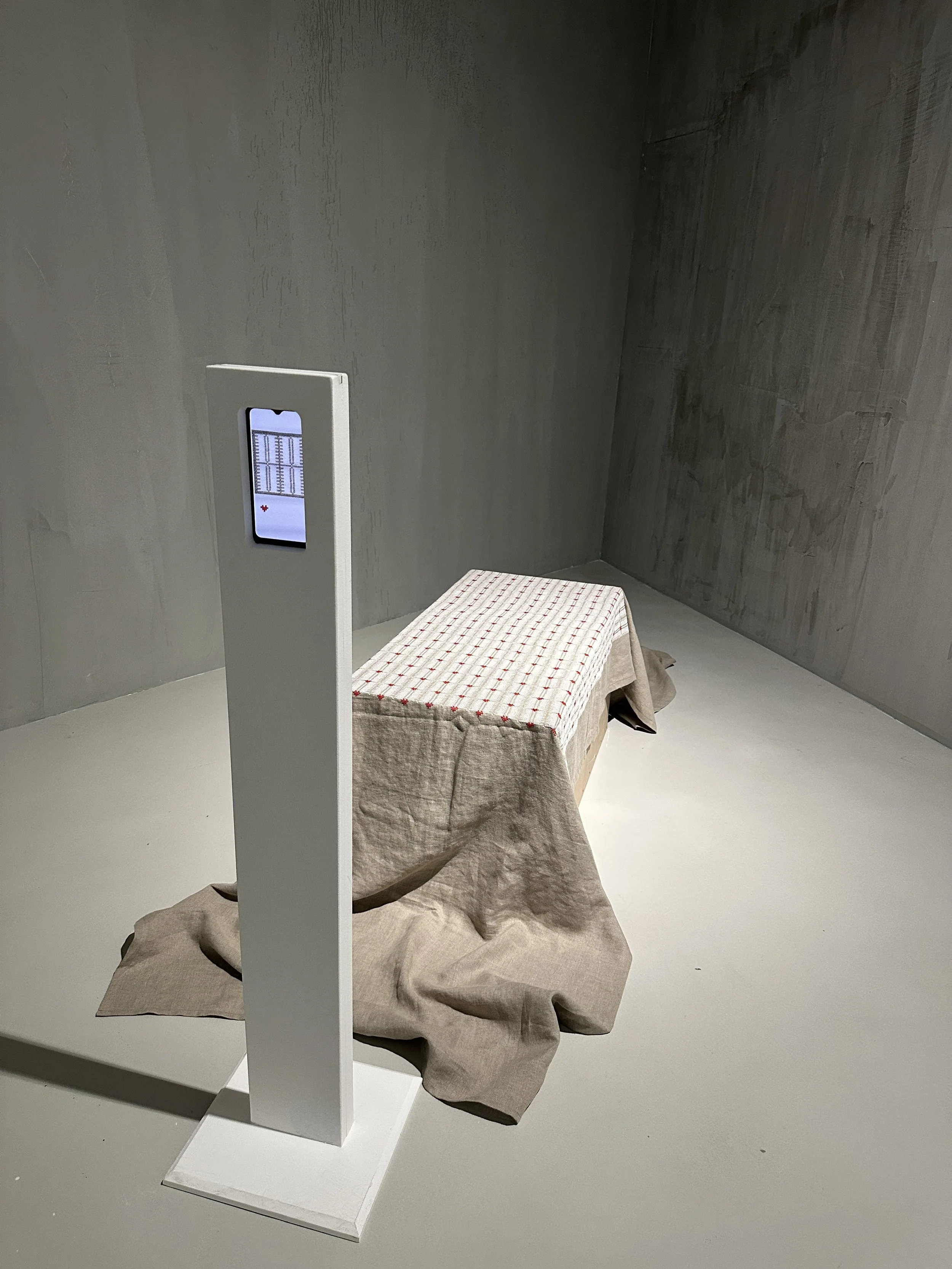
LIKE
Animation, mobile phone, cotton thread on linen, 2025
Sila: All That is Left to You exhibtion, Maraya Art Centre, Sharjah 2025
Al’Qala: Hilos de Historia exhibition, Real Fábrica De Tapices, Madrid 2026
Like, comment, share, and save. Actions once taken for pleasurable content, such as funny memes and cat videos, are now reserved for violence, death, and destruction. The first part of this work is an animation of a social media post trapped in an infinite scroll. The post is made up of the traditional Palestinian Graves embroidery motif, echoing the photographs and videos of mass graves of Palestinians in Gaza during Israel’s genocide of the Palestinian people. There is a red embroidered heart ‘liking’ the content. This work examines the absurdity and profound impact that social media has on how we engage with and collectively remember extreme violence. A primary example of this is the act of 'liking' the unimaginable horror we witness to manipulate social media algorithms that censors and shadowbans Palestinian content.
The second part of this work is a pattern of a Like Heart motif embedded in the traditional Graves motif, hand embroidered on linen and made in collaboration with the Inaash Association’s embroiderers. Creating the Like Heart, modeled after Meta’s ‘like’ heart on Instagram, is an example of the dynamic nature and evolution of motif language. Reflecting on the repetitive nature of scrolling and liking on social media, this artwork highlights how these addictive actions affect our internal and external worlds. Though the piece focuses on how the act of ‘liking’ these painful images is out of alignment with what we feel, one can also reframe it to see the repetition of hearts in this work as a way to encourage compassion and empathy. Integrating and repeating the heart motif in the traditional Graves motif pattern is a reminder to be intentional and conscious when we witness the genocide of Palestinians in Gaza through the little screens glued to our hands.
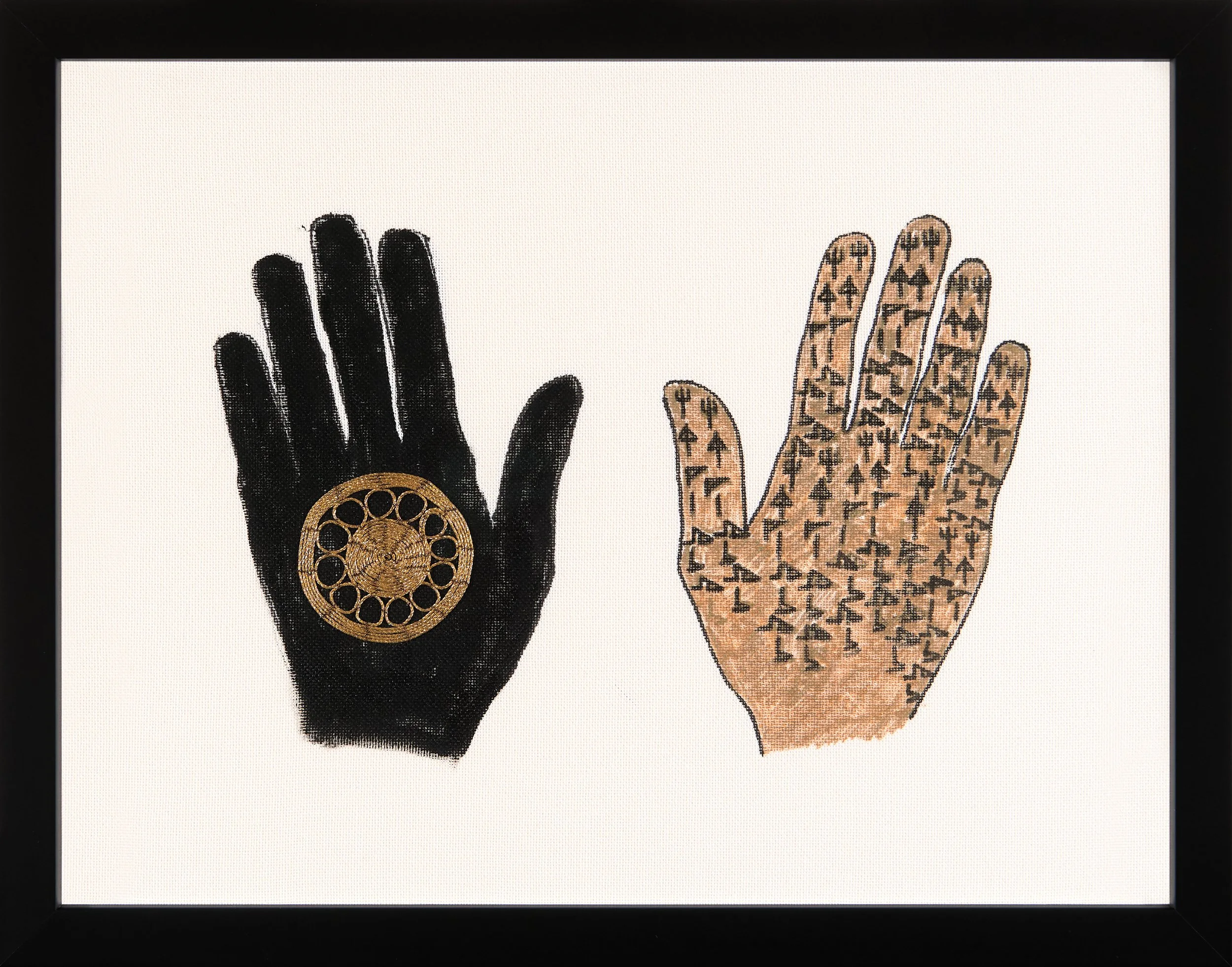
AMULET
2021, Fabric paint and metallic cord on fabric, 30cm x 40cm
Unseen Script, Rizq Art Initiative, Abu Dhabi, UAE, 2026
The Body Language series examines how energy flows through the body in Islamic prayer postures. I simplified the postures into the glyphs, like on the golden hand in this piece. The hands are placed in sujood, or prostration, where the heart becomes positioned above the head. The black hand has couching embroidery (employing the Palestinian tahriri stitch from Bethlehem) that forms a protective eye. Inside the eye around the twelve rings of the spiral, there are twelve circles, a significant number in different sacred, spiritual, and cosmological practices. The protective hands are relevant symbolically for the five fingers representing the five daily prayers and for communicating, channeling, and receiving source energy.
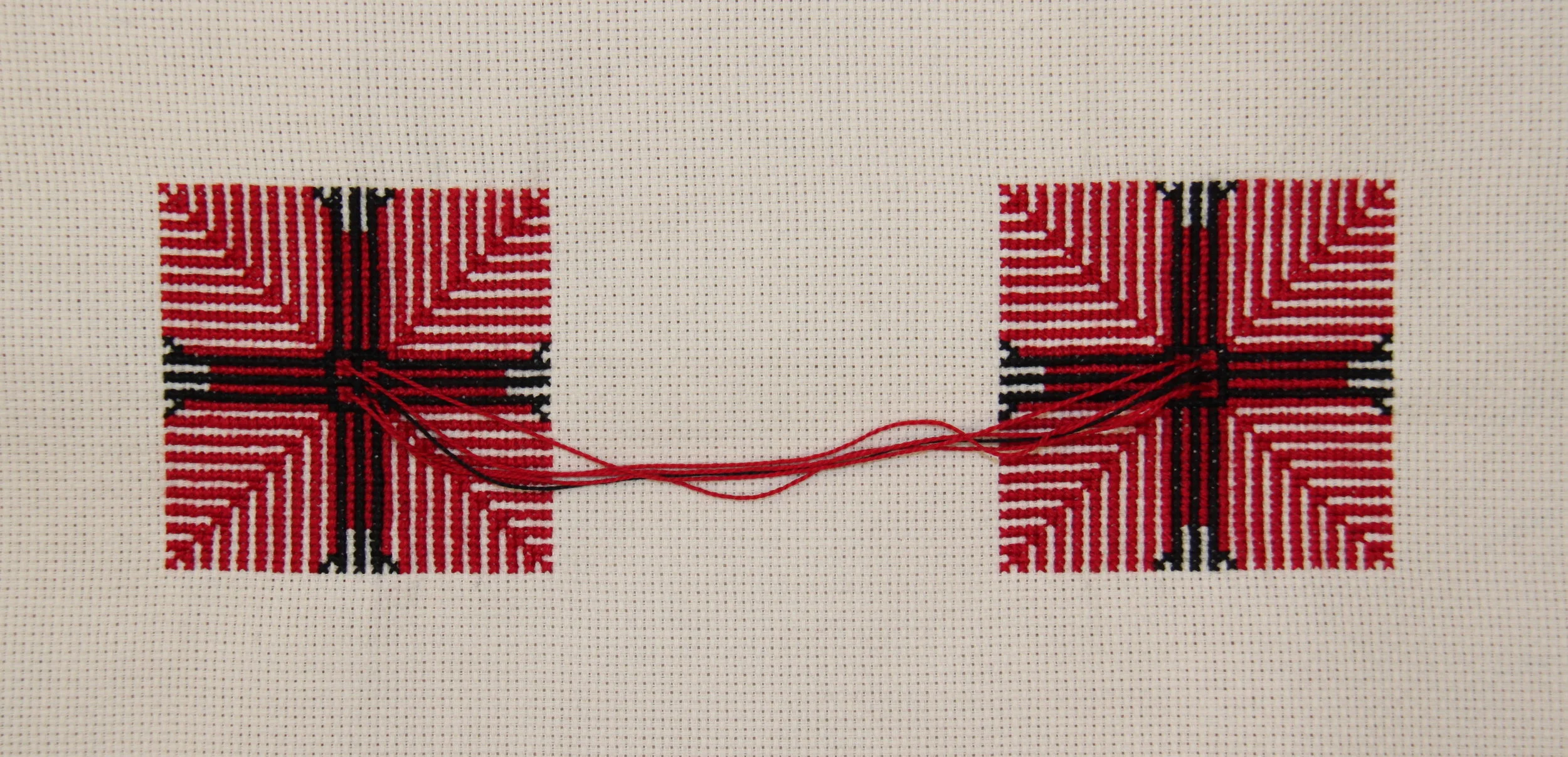
ENTANGLEMENT
2019, Cotton thread on cotton fabric, 15 x 30 cm, Private Collection
Made In Tashkeel, Tashkeel, Dubai, UAE, 2019
Unseen Script, Rizq Art Initiative, Abu Dhabi, UAE, 2026
Featured on the cover of award-winning poetry book Umbilical Discord by Rawand Mustafa.
The theory of quantum entanglement states that even if two particles are physically separated, they can still be connected. Karmic entanglement also speaks of the connection, regardless of space or time, between individuals, an individual to a group of people, or an individual to a belief. In this piece, traditional rules of the symbolic language of Palestinian embroidery are broken and a new translation of the motif is formulated. By understanding entanglement in visual or symbolic terms, an opportunity is created to consider the connecting force or frequency and recognise it as love. Threads emerge from and connect to the four squares centred in each motif, resembling the four chambers of the heart, removing the illusion of separateness while leaving behind the ultimate essence of oneness.

THE WATER SPRING
2019, Cotton thread on linen, 31cm x 31 cm
As Israelis splash around in their swimming pools, irrigate their farms, and boast about making the desert bloom, access to water for Palestinians is a full-blown crisis with Israel controlling and restricting all the water and water-related infrastructure in the West Bank and Gaza. In Gaza, ninety to ninety-five percent of water is contaminated and unfit for human consumption. With ninety percent of the West Bank Aquifer diverted to Israel, settlers in the West Bank consume four times the amount of water as Palestinians (consuming less than the World Health Organization’s daily minimum recommendation). Palestinians have restricted access to the remaining ten percent, intentionally destroying Palestinian agriculture and economy. This piece describes Palestine's water crisis using the same medium and symbolic language of Palestinian embroidery worn by Palestinian farmer and villager women to express their localized identities and personal stories. The disappearing Palestinian embroidery motifs of regional plants, barbed wire, and water spring represent the devastating effect on agriculture in the West Bank caused by the forced separation and restriction to clean and safe water sources. Here is a peek into the near and ominous future where Israel continues to deny Palestinians their human right to water for agriculture and domestic use, adding climate refugees to the pre-existing Palestinian refugee crisis while further aiding in the ethnic cleansing of the indigenous population.