Paintings
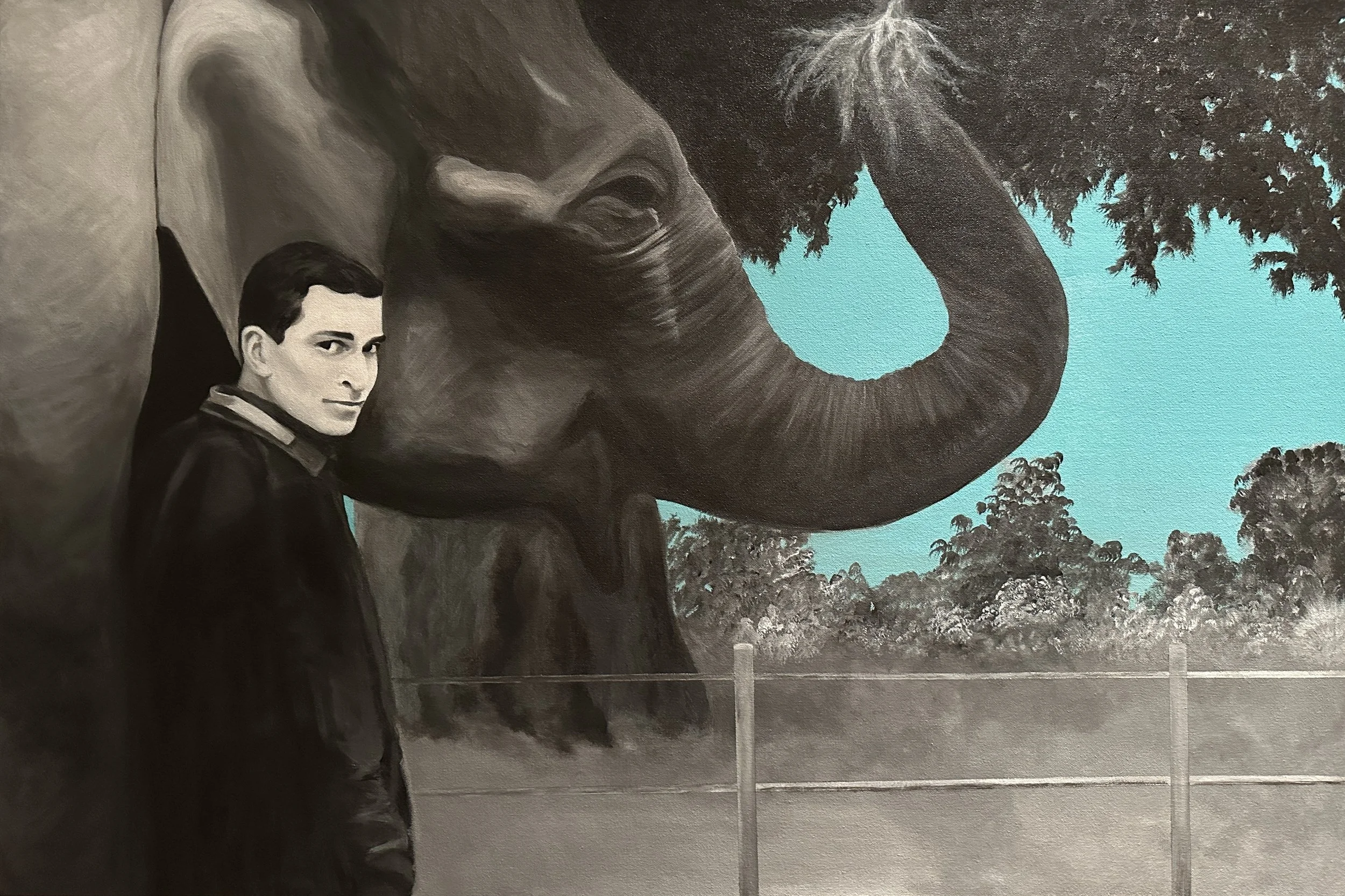
Zoo Garden - Cairo
Acrylic on Canvas, 60 x 90 cm, 2025
Currently on view in The Lost Paintings exhibtion
The reference for this painting is black-and-white photo was taken in 1964 of my father as a young teenager visiting the zoo in Cairo. This was his first trip out of Palestine and marked the beginning of his lifelong path as an antiquities and art dealer. The image, though seemingly ordinary, carries immense weight. My father’s youthful gaze looks to the future and the towering elephant represents the scale of memory and stories carried by the older generations of Palestinians. I am interested in the tension between what is remembered, shared, and lost. There is a bittersweetness in old black-and-white photographs. They capture fragments of time, yet they hint at entire worlds, some now irretrievable. My painting responds to that feeling: the ache of distance, the fragility of cultural inheritance, and the intimate, sometimes unreachable stories passed down between generations. In choosing the title Zoo Garden—Cairo from the list of Lost Paintings for the exhibition, I am invoking my father’s personal history and engaging with a wider meditation on memory, identity, and the losses that live between images and words.

MOHAMMED THE MENACE
Acrylics on canvas, 102 cm x 104 cm, 2021
The conversation starts with me asking the question, “have you heard of Dennis the Menace?” I watch the smile grow as waves of nostalgia flood the brain with images of a troublemaking little white boy and his signature slingshot. Then I ask, “what about Mohammed the Menace?” The combination of these words triggers an instant sense of discomfort. Why is blonde-haired American Dennis not considered threatening, but Mohammed is? In front of you stands my son, Mohammed. He wields a slingshot like Dennis, but he is only a menace in the minds of those who have fallen victim to the propaganda that slipped discreetly into their subconscious via the language, imagery and misrepresentations in news, movies, books, education, social media and social conditioning. Instead of aiming a stone at the tanks and soldiers that brutally oppress and occupy his native land of Palestine, he aims the light of awareness at you. This awareness allows you to become aware of what ideas you allow to reside in your mind and their role in shaping your emotions, judgments, and stereotypes. Blinders are lifted, revealing the greed and violence of white settler colonialism, whose intent is to dehumanize Palestinians to justify the genocide, ethnic cleansing and usurpation of Palestinian land. This awareness will dismantle the imperialistic and colonial infrastructure of your mind to feel and know truth from a place of love.

MOTHER
Acrylic on canvas, 125 x 87 cm, 2020
Some of us fetishize the past; others feel entitled to manipulate it to stake a claim on land inhabited by its indigenous population. We cherish memories that aren’t our own from a time we never experienced. We feel connected to objects we use as evidence of our existence, an imagined past, the past of ancestors, a past that exists only in cultural remnants, stories, and artifacts that survived the constructs of time and nation. This figure of Asherah, the Canaanite mother goddess, serves as a reminder of the people and tribes of the Canaanites, Philistines, and Edomites, inhabitants of the land alongside the twelve tribes of Israel. Though historians and archaeologists may understand Asherah as representing the divine feminine or, according to the Biblical interpretation, an essential member of the Canaanite pantheon, there is no dispute over her creation from the earth of the land of her origin. This large painting of a small artifact holds in it the eternal longing of returning physically and spiritually to our mother, to the source from which we came.
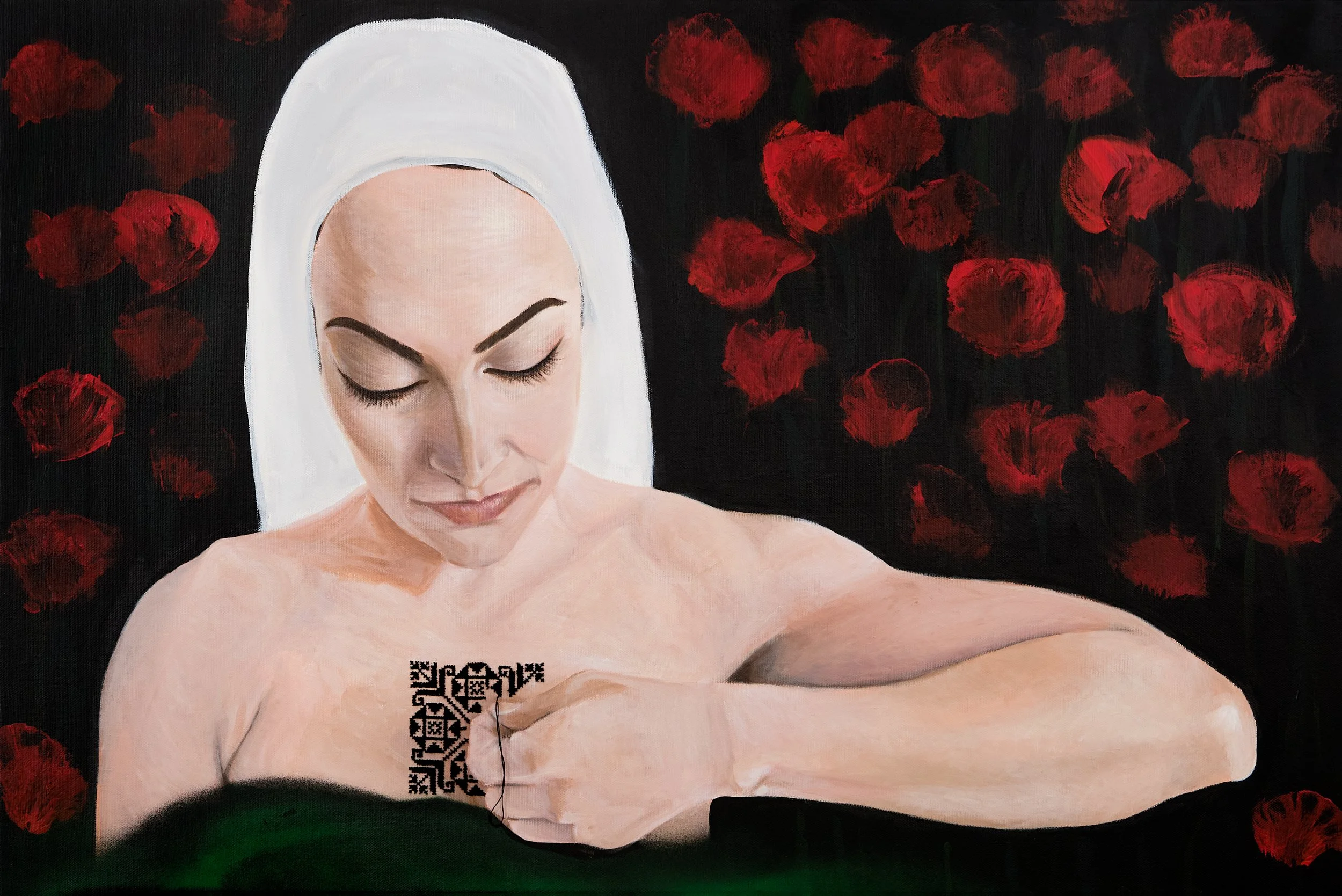
HEART STRINGS
Acrylic, spray paint and cotton thread on canvas, 36 x 24 in / 91.5 x 61 cm, 2017
I paint myself in front of Jerusalem poppies, wearing the traditional white headscarf, cross-stitching a Palestinian embroidery motif straight onto my exposed skin. The embroidery is a way of reclaiming my cultural identity and voice as a Palestinian. Every stitch becomes a letter in an indigenous language that I am slowly becoming more and more fluent in, relieving the feeling of being a foreigner in my native land, skin and mind.
Published in
Barakat, Joanna. Narratve Threads: Palestinian Embroidery in Contemporary Art (Saqi, 2025)
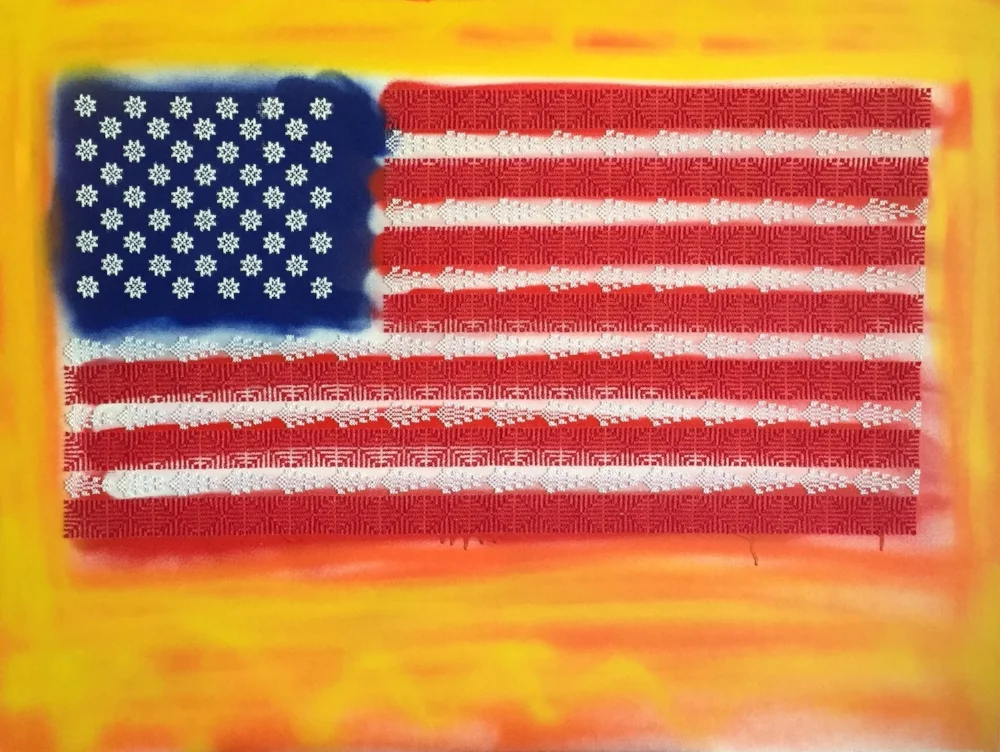
AMERICAN NAKBA
Spray paint and cotton thread on canvas, 30 x 40 in / 76 x 101 cm, 2017
On the surface, American Nakba appears to tell my story as an American immigrant of Palestinian descent. The term, Al Nakba, translating to the catastrophe, refers to when Zionist militia terrorist groups demolished villages, forcibly displaced and massacred Palestinian people in the creation of the ethno-state of Israel in 1948. In the United States, the displacement and attempted erasure of Native Americans and the enslavement of Africans are officially reframed into a triumphant national narrative, seen as necessary chapters in building a proud nation. This national narrative that glorifies settler mythology while silencing the histories it was built on is spoon-fed to Americans by its media, education, and patriotic rhetoric.
This painting confronts that parallel. For over six months, I hand-stitched Palestinian embroidery motifs of stars, trees, and feathers, comprising over 50,000 stitches onto a spray-painted American flag. While the flag evokes mass production, propaganda, and street art, the embroidery carries ancestral memory and indigenous language. By piercing the flag’s surface with thread, I stitch one history into another, forcing them to coexist.
The work questions identity formed through selective memory. What does it mean to claim belonging to a land built upon the death and displacement of others? How different is my Americanness from someone who claims to be Israeli and lives in my occupied homeland? The painting does not offer resolution; instead, it holds contradiction. It asks whether we perpetuate injustice when we accept national myths without interrogating the cost at which they were constructed. Through the collision of spray paint and tatreez, protest and tradition, I examine the uneasy space between privilege and responsibility, inheritance and accountability.
Barakat, Joanna. Narratve Threads: Palestinian Embroidery in Contemporary Art (Saqi, 2025)
https://www.arabnews.com/node/1375001/art-culture
https://gulfnews.com/going-out/events/joanna-barakat-on-art-of-palestinian-embroidery-1.2275242